


What is an Electromagnetic Flow Meter and How Does It Work?
In many industrial processes, measuring liquid flow accurately is not just important—it is essential for efficiency, safety, and cost control. One of the most widely used instruments for this purpose is the electromagnetic flow meter, often called a mag meter.
You will commonly find it in water treatment plants, chemical processing units, food and beverage industries, and wastewater management systems. Reliable manufacturers such as Mial Instruments offer advanced electromagnetic flow meters designed for industrial-grade applications where accuracy and durability matter.
So, what exactly is this device, and how does it actually measure flow without any moving parts? Let’s understand it in a simple, practical way.
Understanding the Electromagnetic Flow Meter
An electromagnetic flow meter is an instrument used to measure the flow rate of conductive liquids. It works on a very scientific principle called Faraday’s Law of Electromagnetic Induction.
What makes it different from traditional mechanical flow meters is its design—there are no moving parts inside it. This makes it more reliable, less prone to wear and tear, and suitable for demanding industrial environments.
It is commonly used for:
- Water and wastewater
- Chemicals such as acids and alkalis
- Slurries and sludge
- Food-grade liquids like milk, juice, and syrups (in hygienic versions)
One important condition is that the liquid must be electrically conductive. Non-conductive fluids like oil or gas cannot be measured using this type of meter.
The Principle Behind It: Faraday’s Law
The working of an electromagnetic flow meter is based on a simple idea from physics:
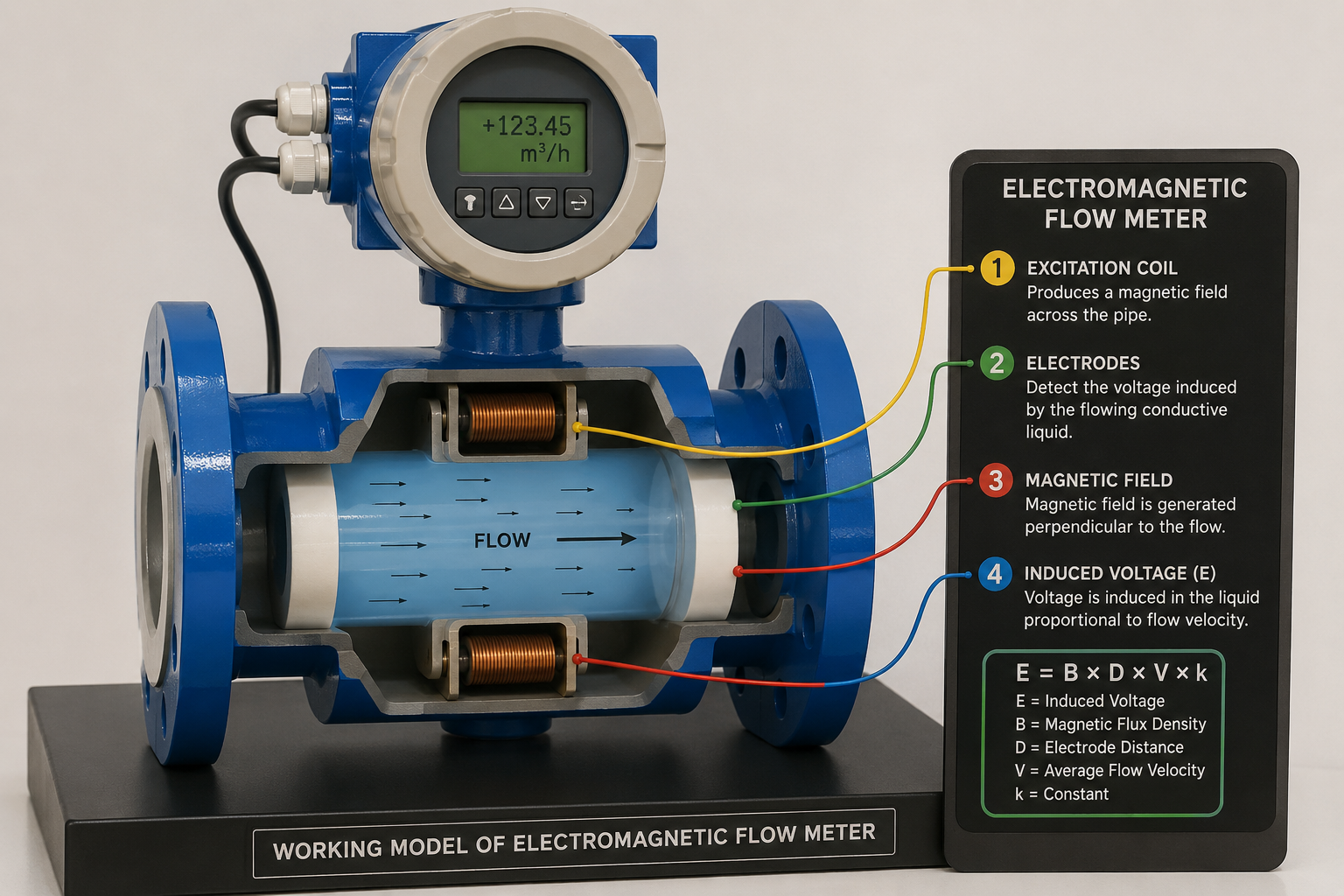
When a conductive liquid moves through a magnetic field, it generates a voltage. This voltage is directly proportional to the velocity of the liquid.
In simpler terms:
- Faster flow = higher voltage
- Slower flow = lower voltage
This small voltage is what the meter measures and converts into a readable flow rate.
How an Electromagnetic Flow Meter Works
Although the technology is advanced, the working process can be understood step by step.
1. Creating a Magnetic Field
Inside the meter, coils generate a magnetic field across the flow tube. This field is applied perpendicular to the direction in which the liquid flows.
2. Liquid Passes Through the Field
When the conductive liquid flows through the pipe, it moves through this magnetic field. At this point, the liquid essentially behaves like a moving electrical conductor.
3. Voltage is Generated
As the liquid moves, a small voltage is induced. This voltage is directly proportional to how fast the liquid is flowing.
4. Electrodes Capture the Signal
Electrodes placed inside the flow tube detect this induced voltage. These electrodes are highly sensitive and pick up even very small changes.
5. Signal is Converted into Flow Data
The transmitter processes the voltage signal and converts it into usable flow information such as:
- Instant flow rate (liters per minute or cubic meters per hour)
- Total accumulated flow
This data can then be displayed locally or integrated into automation systems like SCADA or PLCs.
Main Components of the Device
An electromagnetic flow meter may look simple from the outside, but it consists of several important parts working together:
Flow tube (liner): The internal pipe where liquid flows. It is usually coated with materials like rubber, PTFE, or ceramic to resist corrosion and wear.
Magnetic coils: These generate the magnetic field required for measurement.
Electrodes: These detect the voltage produced by the moving liquid.
Transmitter: The electronic unit that processes signals and displays flow readings.
Housing: Provides protection against environmental and industrial conditions.
Advantages in Real Industrial Use
Industries prefer electromagnetic flow meters for several practical reasons.
The biggest advantage is that there are no moving parts, which means very little maintenance and a longer operational life.
They are also highly accurate and perform well even when the liquid contains impurities like sludge or suspended particles.
Other key benefits include:
- High measurement accuracy
- No pressure loss in the pipeline
- Suitable for dirty and corrosive liquids
- Ability to measure flow in both directions
- Stable performance over long periods
Limitations You Should Know
Like any instrument, electromagnetic flow meters also have some limitations.
They can only measure liquids that conduct electricity, which means they cannot be used for gases, steam, or oils.
They also require a stable power supply to operate, and proper installation is important. For example, grounding and straight pipe length are necessary for accurate readings.
Where They Are Commonly Used
These flow meters are widely used across multiple industries because of their versatility:
In water and wastewater treatment plants, they help monitor inflow and outflow accurately.
In the chemical industry, they safely measure corrosive liquids like acids and alkalis.
In manufacturing plants, they support process control and cooling system monitoring.
In food and beverage production, hygienic models ensure safe measurement of liquids like milk, juice, and syrups.
In mining and slurry handling, they are used to measure thick and abrasive fluids without clogging issues.
Why They Matter in Modern Industry
With industries moving toward automation and smart monitoring systems, electromagnetic flow meters have become more important than ever.
They help improve process efficiency, reduce wastage, and ensure accurate monitoring of liquid movement. They also integrate easily with digital systems, making them a key part of modern industrial automation setups.
Final Thoughts
An electromagnetic flow meter is a smart and reliable solution for measuring the flow of conductive liquids. Its working principle is simple in concept but powerful in application, offering high accuracy without mechanical wear and tear.
From water treatment plants to chemical industries, it plays a crucial role in ensuring smooth and efficient operations. As industries continue to modernize, these meters will remain an essential part of process control and measurement systems.